


FLASH NEWS
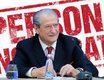
On the 5th anniversary of Berisha's "non grata", those in power want him removed!

2026-05-19 20:09:16 / IDE
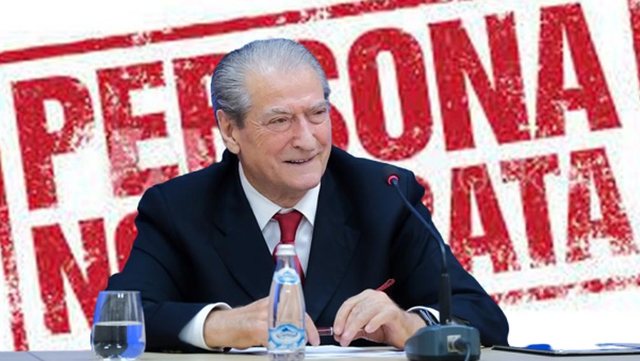
Today, May 19, marks five years since the US sanctioned Sali Berisha on the grounds that he was a leader who undermined democracy, engaged in major corruption with his family members during his time in power, and blackmailed the justice system.
The US applies roughly three types of sanctions: State Department sanctions based on Section 7031(c) of the State Department Act, Treasury Department sanctions, and Presidential executive orders, as sanctions against persons punished by the US President are called in the Balkans.
The difference between State Department sanctions and Treasury Department sanctions is that State Department sanctions are made by public announcement, are political in nature, cannot be appealed in court, and are very difficult to revoke, as a strong political, geopolitical, or US national interest argument is needed to silently lift the sanctions.
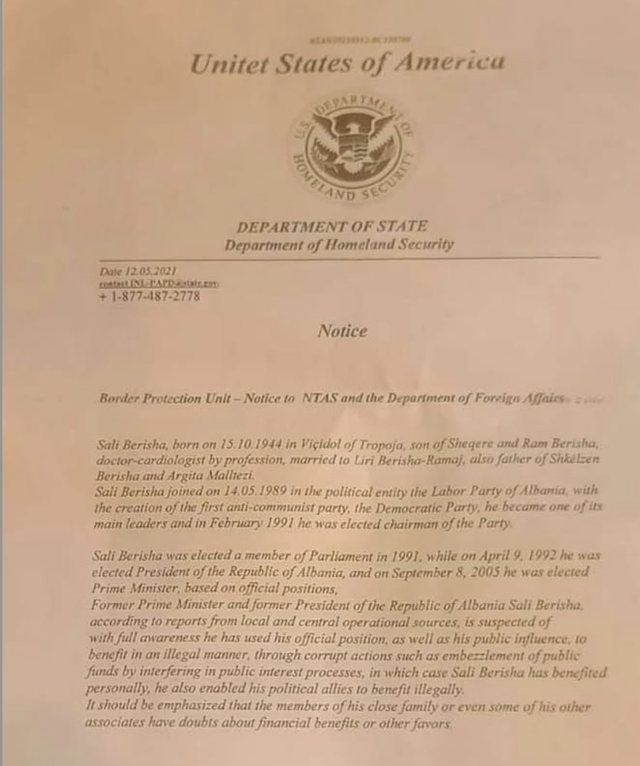
The US President's executive orders deal with individuals who endanger peace in the region and create problems for regional stability and US interests.
So, to put it simply, Sali Berisha has been sanctioned not for any specific act, but for the entire history of his political life, which for the US is an undermining of democracy, while his governance has been a history of involvement in major corruption together with his family members, blackmailing justice.
To date, there has been no case of State Department sanctions being lifted for all sanctioned individuals. There have been several cases of conditional sanctions relief by the President's executive orders and those sanctioned by the Treasury Department for financial abuses and ties to organized crime.
One such was Dodik in Bosnia, who had his Treasury Department sanctions eased after talks to step away from politics and pave the way for a leadership change on the part of the Bosnian Serbs.
Unlike other politicians in the world, Berisha's dealing with sanctions is atypical. For most politicians, sanctions have served to remove them from politics and retire them, while for Sali Berisha, sanctions have served to return to active politics formally. He was the shadow chairman of the DP and after the sanctions he started the battle with the DP leadership to return by using parallel structures in the party to expel them from the party.
So Sali Berisha considered the sanctions as a challenge to him from the US and opposed their goal, which was to remove him from politics. And in a way, he succeeded.
Sali Berisha has defeated the US on this point. He has shown that in the Democratic Party between Sali Berisha and the US, Sali Berisha is elected and for this reason he has devalued his sanctioning by the US. This at least had a strong political value for him and was becoming his political identity until the fall of 2024, when he had based all his rhetoric on the political sanctioning by the Democrats.
Sali Berisha began to lose the moral battle against the US after President Trump's victory, when he paid his campaign advisor $6 million to remove his "non-women's names." This showed that his victory against the US was fake and he wanted to pay to have it certified.
After almost a year since his expensive payment for the removal of the "non grata", he continues to be sanctioned, even though the efforts to remove it have many times more millions of dollars available than those declared. The reason is that the US must open a door that it has never opened to date, not for any American interest in the region, but for the pride of an old man who has taken the DP hostage in Albania and tells them "if you don't lift the sanctions, I will kill him". And it is taking his soul day by day.
In the principle of their foreign policy, the US does not surrender to hostage-takers and usually kills them along with the hostages if necessary. So Berisha must find some other way to make it easier for those who have given him millions to lift the sanctions. The easiest way is to release the hostage and go home. That way, even if they do not legally lift the sanctions, he can keep the glory of challenging them by defeating them before making a deal with the lek.
The truth is that in Albania this is no longer a matter for debate. In fact, many of those in power have a secret desire for sanctions to be lifted in order to make them ridiculous as a mechanism and have no impact on them in the future.
The problem is that the US does not have any national interests that Berisha can fulfill or any challenges he faces in the Balkans that political bargaining can justify Berisha's millions under his belt.
Therefore, it is better to continue like this. Whenever Berisha has a problem, he can open his mouth that the sanctions will be lifted until the last hope dies. As Berisha says: it is in the last mile.
Happening now...




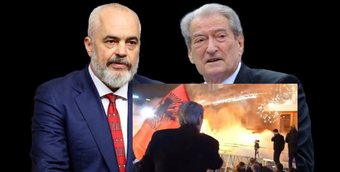
Molotov cocktail on Saturday, shopping on Thursday!
Nga Bato Kosova
ideas
top








services
- POLICE129
- STREET POLICE126
- AMBULANCE112
- FIREFIGHTER128